Microservices Architecture Patterns for Embodied AI in Humanoid Robotics Projects
Step-by-step guide to designing scalable microservices for physical AI robots, improving backend development reliability with Node.js examples for emerging tech builders.
# Struggling to keep your humanoid robot's AI responsive amid complex embodied tasks? Discover how microservices architecture with Node.js unlocks scalable backend development for robotics projects.
By the end, you'll have a step-by-step guide with practical Node.js code examples to implement microservices architecture patterns tailored for embodied AI in humanoid robotics. This boosts scalability, flexibility, and real-time performance while tackling robotics challenges head-on.
## What Is Microservices Architecture, and Why Does Humanoid Robotics Crave It?
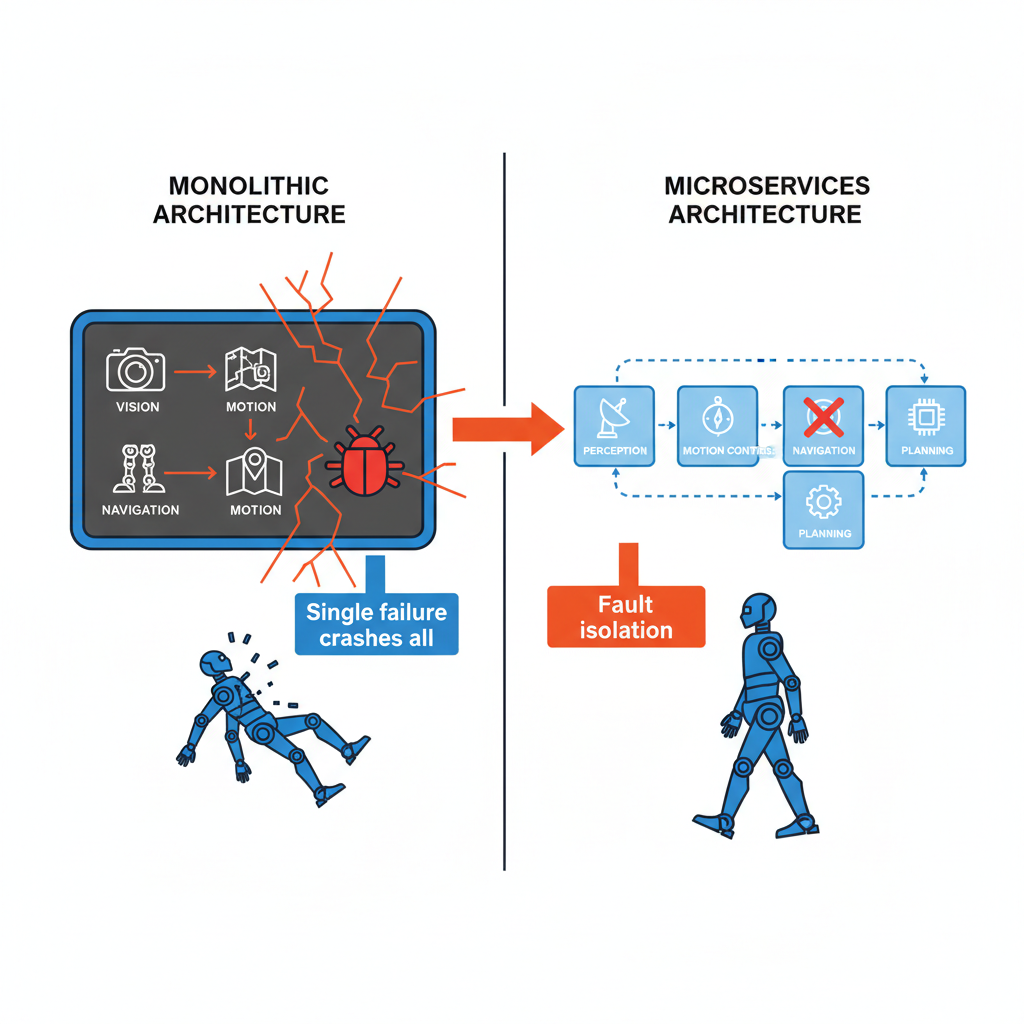
Microservices architecture chops applications into small, independent services that chat over networks. Each one tackles a specific job, say processing sensor data or steering actuators. They run in their own processes. Monoliths cram everything into one big codebase. In humanoid robotics, that's a disaster waiting to happen. A glitch in vision could lock up the whole robot, stopping it dead while it's trying to grab something fragile.
Humanoid bots need this modularity. They juggle real-time feeds from cameras, lidars, IMUs, plus AI calls for balance and pathfinding. One failure in a monolith? Your biped could topple mid-stride. Take NUClear, a modular setup for humanoid robots from Frontiers in Robotics and AI. It pushes functional, swappable designs that echo microservices architecture. Perfect for embodied AI, where projects blend perception, planning, and action without constant reboots. Microservices push that resilience right into your backend.
## The Big Wins: How Microservices Supercharge Embodied AI
Scalability jumps out first. Perception services drown in video frames. Navigation spikes during dodges. Scale them separately. No need to beef up the entire system.
Fault isolation saves the day. Say the arm control service hiccups on a SamuRoid humanoid. Those 22 degrees of freedom run on XRS300 servos packing plenty of torque, as noted on Hackaday.io. Vision keeps chugging. No full blackout.
Mix tech stacks freely. Node.js for zippy orchestration. Python for ML brains. Teams move faster, prototyping in parallel. Recent reviews on embodied AI with foundation models highlight integration headaches for mobile bots. They scream for scalable setups. Microservices nail it. Test motion tweaks without messing with NLP.
## Why Node.js Rules Scalable Backends in Robotics
Node.js shines in robotics backends with its event-driven, non-blocking I/O. Sensors spit out endless streams: joint angles, depth maps, voice. Node.js slurps them up asynchronously. No stalls. And it's light for onboard edge compute, where every watt counts.
The ecosystem seals the deal. Express.js whips up REST APIs fast. Socket.io handles real-time WebSockets for teleop or fleet sync. Cylon.js, that JS robotics framework, backs a ton of platforms with one API. Node.js fits humanoid gigs like a glove. Control servos, stream AI outputs, no sweat. It crushes high-throughput inference without latency that'd tip a walker.
## Must-Know Microservices Patterns for Humanoid Bots
These patterns click perfectly for robotics:
- **API Gateways**: Your front door. Routes "walk to target" to the right service. Handles auth. Centralizes fleet control, throttles demo overloads.
- **Service Discovery**: Consul or Eureka track services as they pop in and out. Vital for scaling robot squads.
- **Event-Driven Flows**: Pub/sub with RabbitMQ or Kafka. Decouples sensor floods from AI consumers.
- **Resilience Tricks**: Circuit breakers (opossum in Node.js) cut off dead services. No cascades in decision loops. Sagas orchestrate grabs: plan, arm out, confirm grip.
Papers on these patterns for complex systems line up spot-on with robotics demands.
## Build It Step-by-Step: Node.js Microservices for Robots
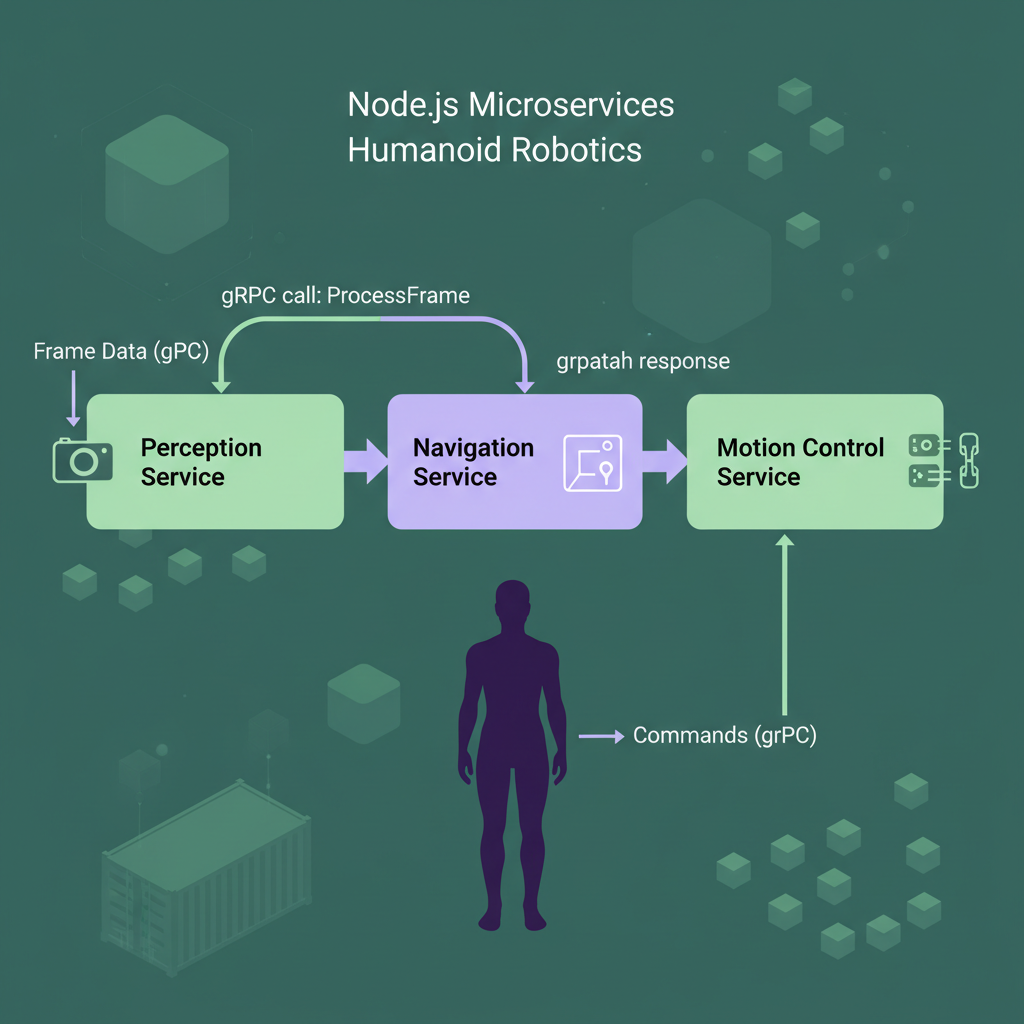
Kick off three services: perception for cams, motion for actuators, navigation for paths. Grab NestJS. It packs microservices support.
Perception first. `npm init -y && npm i @nestjs/core @nestjs/microservices @grpc/grpc-js @grpc/proto-loader`.
Protobuf for images:
```proto
syntax = "proto3";
service PerceptionService {
rpc ProcessFrame(ImageData) returns (Detections);
}
message ImageData { bytes data = 1; }
message Detections { repeated string objects = 1; }
```
Stubs ready, hit `perception.service.ts`:
```typescript
import { Controller } from '@nestjs/common';
import { GrpcMethod } from '@nestjs/microservices';
@Controller()
export class PerceptionController {
@GrpcMethod('PerceptionService', 'ProcessFrame')
processFrame(data: any) {
// Fake YOLO run
return { objects: ['human', 'obstacle'] };
}
}
```
Dockerize: `FROM node:18-alpine`, copy, install, expose. `docker build -t perception.`. GRPC for tight comms. Navigation pings perception:
```typescript
async getPath(target: string) {
const detections = await this.client.getService('PerceptionService').ProcessFrame({ data: frameBuffer }).toPromise();
// Dodge 'em
return { waypoints: [...] };
}
```
Docker Compose for tests. Kubernetes for prod. Nails robot loops.
## Wiring in AI Components with Microservices
Embodied AI loves modularity. Dedicated services: OpenCV vision, speech-to-intent NLP, trajectory planners. Kubernetes pods per limb or brain chunk.
Keep latency low for balance. Node.js promises and observables flow smooth. Proxy TensorFlow via REST. Fuse inferences with sensors.
AllenAct's modular embodied AI sim from 2020 eases real-bot jumps. Train there, deploy to inference services. SamuRoid blends AI with biped walks, managing 22 DOF via those beefy servos. Microservices keep it precise.
## Tools, Tips, and What's Next for Robotics Microservices
Monitor: Prometheus, Grafana for latency, errors, CPU on clusters. Secure with OAuth2, mTLS. Labs get nosy.
NestJS, Moleculer speed Node.js micros. NUClear's low-latency modularity holds up.
Edge AI goes serverless: Lambda, OpenFaaS onboard. K8s for swarms, syncing tasks. Foundation model reviews peg scalability as the hurdle for physical AI. Node.js microservices architecture cracks it today.
You're set with these patterns and Node.js tricks for artificial intelligence in humanoids. Dive in. Future technology in robotics waits for builders like you.