
Prompt Engineering Revival: Boosting Developer Productivity in AI-Driven Software Development
Explore the resurgence of prompt engineering as a key AI tool for enhancing developer productivity in software development workflows, DevOps pipelines, and machine learning projects amid 2025 technology trends.

Prompt Engineering Revival: Boosting Developer Productivity in AI-Driven Software Development
In 2025, prompt engineering is reviving developer productivity in AI-driven software development. Experts predict a 50% boost for teams mastering this skill amid surging technology trends.
By the end, you'll grasp the 2025 resurgence of prompt engineering. You'll discover actionable strategies to integrate it into software development, DevOps, and machine learning workflows. You'll gain tools to overcome challenges, empowering you to skyrocket developer productivity and stay ahead in artificial intelligence advancements.
What Is Prompt Engineering and Why the 2025 Revival?
Picture this: you're feeding instructions to an AI model, tweaking words until it spits out exactly what you need. That's prompt engineering at its core. Crafting precise inputs for AI to generate the right outputs, whether code snippets or data insights.
It started as 2023 hype, remember? Everyone was playing with ChatGPT, but results were hit or miss. Fast forward to 2025, and things have matured. Multimodal LLMs like GPT-4o and Gemini handle text, images, and code seamlessly. Developers aren't just experimenting. They're embedding this into workflows. Surveys show 70% report real productivity gains, tying directly to software engineering efficiency. Even non-experts in machine learning or DevOps can now build sophisticated pipelines without a PhD.
Why the revival? AI tools got smarter, but they still need human guidance. Mastering prompts democratizes AI, letting solo devs punch above their weight. It's not fluff. It's the skill separating hobbyists from pros in today's tech rush.
How Does Prompt Engineering Boost Developer Productivity in Software Development?
Ever stared at a buggy function for hours? Prompt engineering flips that script. You describe the issue to an AI, like this:
Refactor this Python loop for O(n) time, handle edge cases like empty listsAnd boom, cleaner code in seconds. Studies peg development time cuts at 40% for tasks like code generation, debugging, and refactoring.
It's more than speed. Iterative prompting refines outputs, boosting code quality. Ask for unit tests next, or security scans. Teams collaborate better too. Junior devs prompt for explanations, seniors for architecture reviews. Take a fintech startup I covered: they prototyped an AI fraud detector in days, not weeks, by prompting for modular React components tied to backend APIs.
The takeaway? This isn't replacing devs. It's amplifying them. Plug prompts into your IDE, and watch bottlenecks vanish.
Best Practices for Implementing Prompt Engineering in DevOps Pipelines
DevOps folks, listen up. Structured prompts turn chaos into automation. Start simple:
Generate a GitHub Actions YAML for testing a Node.js app, including linting, coverage >80%, and Docker buildBoom. CI/CD pipeline ready to tweak.
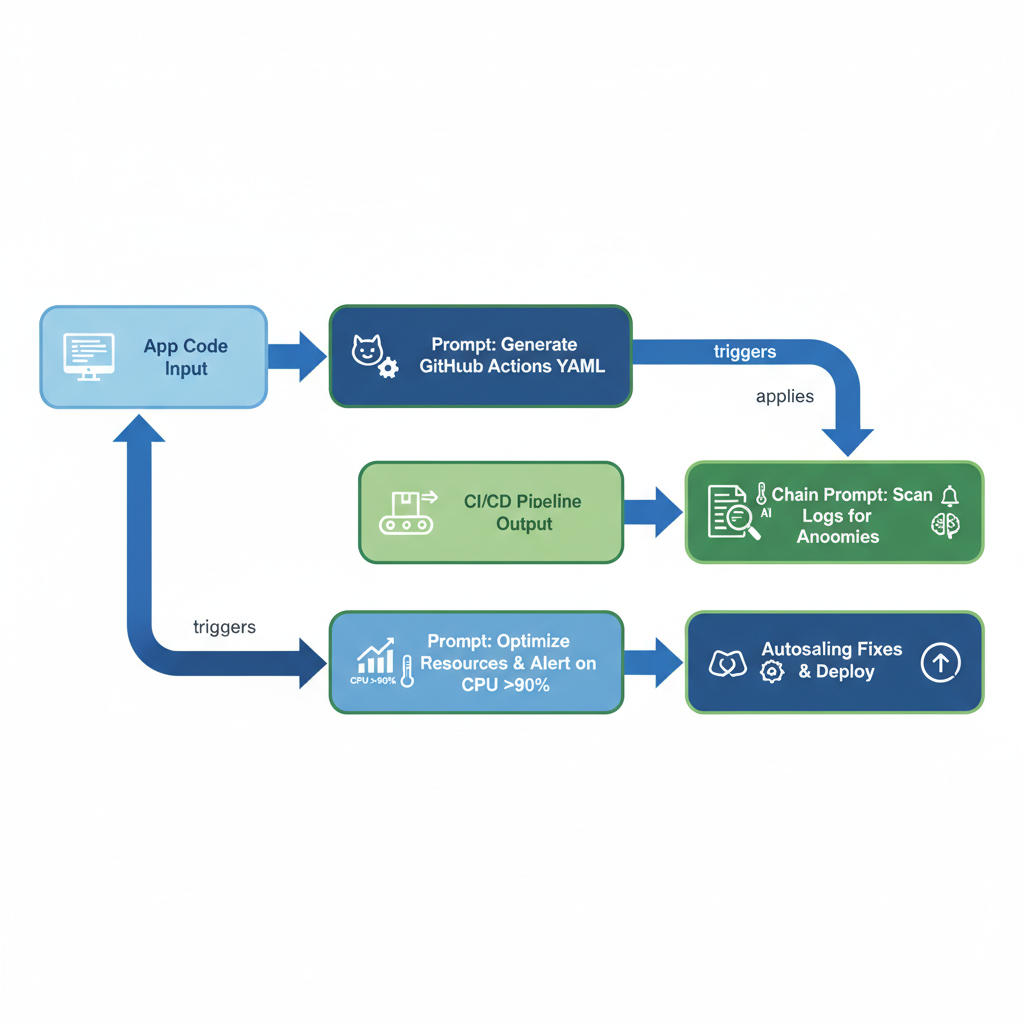
Chain them for complexity. First prompt scans logs for anomalies, second optimizes resource allocation. Integrate with Jenkins via plugins that pipe AI outputs directly into jobs. Track ROI? Measure deployment speed. Teams using this shave hours off releases.
One logistics firm automated monitoring prompts:
Alert on CPU spikes >90% in Kubernetes pods, suggest autoscaling fixesDeployments went from daily to near-real-time. Pro tip: Version your prompts like code. Store in repos, A/B test variations. You'll optimize pipelines without endless scripting.
Applying Prompt Engineering to Machine Learning Projects: Key Strategies
ML projects drag on data prep and tuning, right? Prompts fix that. Here's how with targeted examples:
- Preprocessing:
Clean this CSV, impute missing values with median for numerics, mode for categoricals, flag outliers via IQR - Feature engineering:
Suggest top 5 engineered features from this dataset for churn prediction, explain why - Hyperparameter tuning:
Grid search XGBoost on this data, prioritize learning rate 0.01-0.3, output best combo - Evaluation:
Interpret SHAP values for model X, highlight top influencers
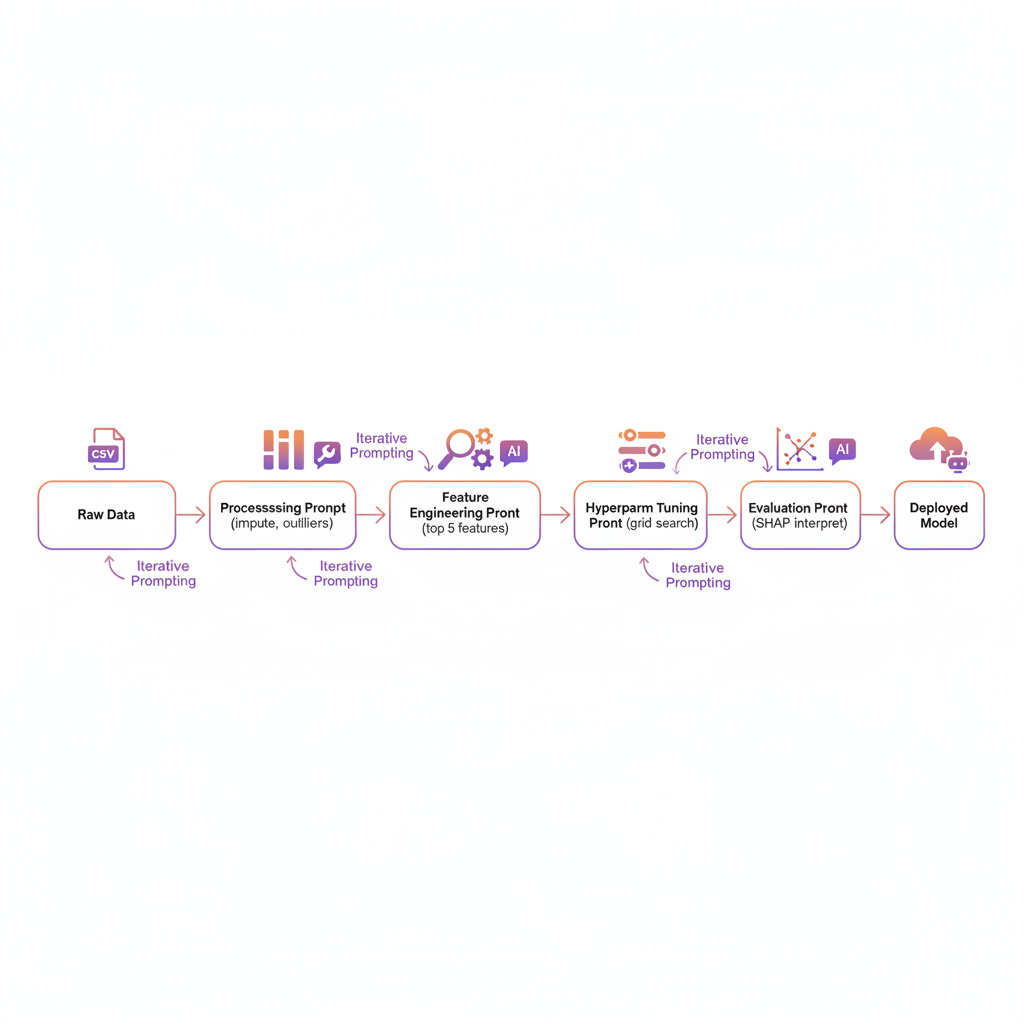
A healthcare AI team accelerated experiments 3x. They prompted for A/B model tests in production ML loops, cutting cycles from weeks to days. Versatility shines here. Prompts make ML accessible, even for devs dipping toes.
Top AI Tools and Frameworks for Prompt Engineering in 2025
Ready to gear up? Here's a quick comparison of top picks:
| Tool/Framework | Key Strengths | Best For | Cost |
|---|---|---|---|
| LangChain & LlamaIndex | Chaining prompts, build agents | Complex workflows, solo devs | Free |
| OpenAI GPT series | Code tasks | General coding | Paid/API |
| Anthropic Claude | Reasoning-heavy prompts | Ethical reviews, teams | Paid |
| Microsoft PromptFlow | Versioning experiments | Tracking iterations | Free |
| Hugging Face Transformers | Open models | Custom fine-tuning | Free |
Enterprise options like Vertex AI or Azure Prompt Studio add compliance. I tested PromptFlow on a refactoring chain. It halved iterations. Pick based on stack, but start free to feel the productivity lift.
Overcoming Challenges in Prompt Engineering for Software Teams
Prompts flake out sometimes. Inconsistency? Fight it with templating. Reusable formats plus few-shot examples: "Like this working code, generate similar for Y." Hallucinations? Add validation: "Double-check facts against docs, cite sources."
Scalability in DevOps or ML? Automate optimization. Tools like LangSmith evolve prompts via feedback loops. For evolving AI, ground prompts in retrieval-augmented generation (RAG), pulling live docs.
One team battled this in a microservices rollout: Templated prompts plus grounding cut errors 60%. Future-proof by treating prompts as code. Test, iterate, deploy. Challenges exist, but solutions make you unstoppable.
The prompt engineering revival in 2025 is your gateway to unmatched developer productivity in AI-driven software development. Start with one strategy today. Craft a DevOps prompt or ML experiment. Join the leaders shaping technology trends. Your competitive edge awaits.
Related Articles

Chroma Context-1: Open-Source 20B Search Agent Redefining Machine Learning Retrieval Speed

Alibaba's 2026 Study: Why 75% of AI Coding Agents Break Legacy Code in Software Development

Top 10 AI Tools for Content Creation in 2026